









What is a queue line?
A queue line is an ordered sequence of people, or tasks, waiting to be served in the order they arrive — the “first come, first served” principle. A queue line can be physical (people standing at a counter), virtual (a digital ticket that holds your place), or mobile (managed from a phone). Businesses manage queue lines to keep service fair and cut waiting time.

That definition sounds simple, yet the way you design and manage a queue line decides whether customers leave delighted or frustrated. Below we cover what a queue line actually is, the main types, how to reduce the wait, and how a modern queue management system turns a line into a smooth, measurable process.
Queue line vs “que”: clearing up the spelling
Search data shows a great deal of confusion around the word, so let’s settle it before we go further.
- Queue — the correct spelling for a line of people or items waiting their turn. You wait in a queue or in the queue line.
- Que — not standard English for a line. It is a homophone (it sounds identical to “queue”) but refers to the Spanish word for “what” or an abbreviation of Quebec. You cannot “queue in line” using “que”.
- Cue — a signal or prompt to begin an action. You cue up a video; you queue up for a service.
So if you are referring to people waiting their turn, “queue line” is correct every time.
The three main types of queue line
Almost every waiting scenario falls into one of three categories. Most businesses eventually run a blend of all three.
1. Physical queue line
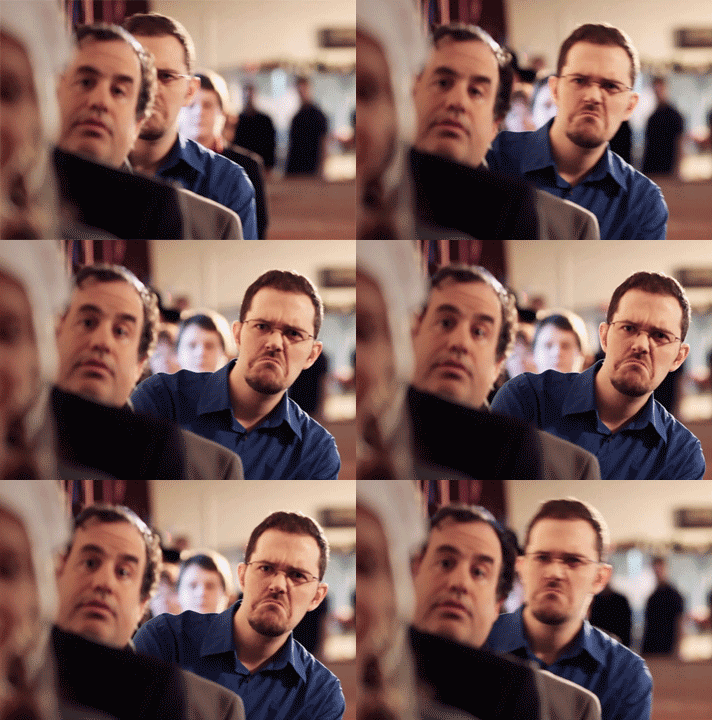
The classic line: customers stand on-site and wait their turn. It needs physical space, signage, and often staff to keep order. It is simple to understand but the hardest on the customer — standing still with no visibility of the wait is where impatience builds fastest.
2. Virtual queue line
Customers check in at a kiosk, tablet, or web link and receive a digital place in the line. They can see roughly how long the wait is and are free to sit, browse, or step away until called. The line still exists — it is just no longer a physical scrum.
3. Mobile queue line
An extension of the virtual queue, run entirely from the customer’s own phone. They join remotely, track their position in real time, and receive a notification when it is nearly their turn. This removes travel and standing time almost entirely and is the model most modern queue management platforms are built around.
Comparison table: how the three queue line types stack up
| Factor | Physical queue line | Virtual queue line | Mobile queue line |
|---|---|---|---|
| Where the customer waits | On-site, in person | On-site but free to move | Anywhere |
| Visibility of wait time | None to low | Medium | High (real-time) |
| Space & staff cost | High | Medium | Low |
| Perceived wait | Longest | Shorter | Shortest |
| No-show risk | Low | Medium | Managed via reminders |
| Best for | Walk-in only | Mixed footfall | Appointment-led, high-volume |
Why do queue lines form? A one-minute history
There is real science behind the queue line. In 1909, Danish engineer A. K. Erlang founded queueing theory while working at the Copenhagen Telephone Exchange, trying to work out how many operators and lines were needed for smooth service. His formulas still underpin call centres, servers, and — yes — the line at your local bank.
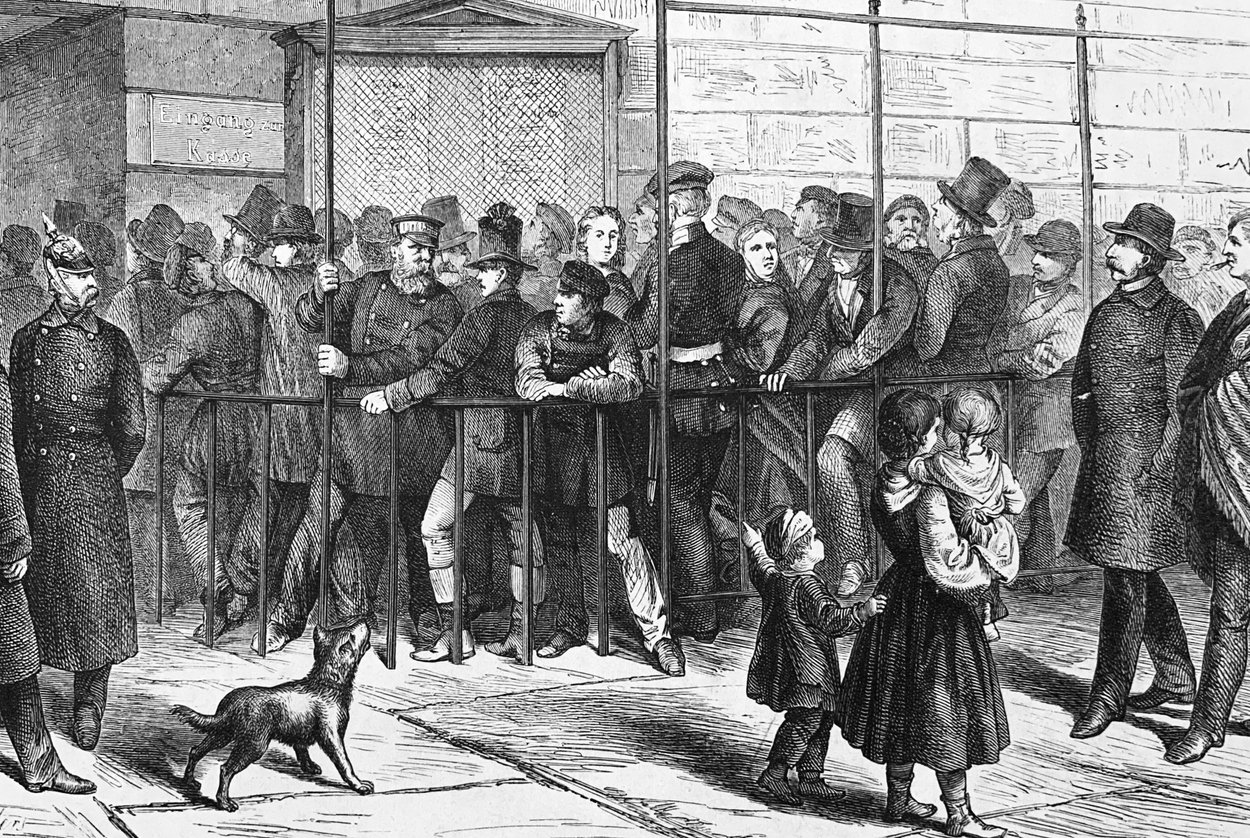
Queueing theory boils down to two parties: the customer (who requests a service) and the server (who delivers it). A queue line forms whenever customers arrive faster than servers can handle them. The practical questions every operations manager should ask are the same ones Erlang asked:
- How many customers arrive, and how quickly?
- How many servers do we have, and how fast is each one?
- How much waiting capacity do we have before people give up and leave?
Answering these is how you decide whether you need more staff, better scheduling, or a smarter queue line system.
The psychology of the queue line
People do not actually hate waiting — they hate uncertain, unexplained waiting. Research into queue psychology consistently finds that:
- Unoccupied time feels longer than occupied time. A five-minute wait with nothing to do feels worse than a ten-minute wait spent doing something useful.
- Uncertain waits feel longer than known, finite waits. “You are number 4, roughly 8 minutes” is far more tolerable than an invisible line of unknown length.
- Unfair waits feel worst of all. If someone who arrived later is served first, satisfaction collapses regardless of the actual wait time.
The takeaway for anyone designing a queue line: give people information, give them their time back, and keep the order visibly fair. A virtual or mobile queue line does all three by default.
How to reduce queue line wait times (step by step)
You do not need to master queueing theory to fix your line. Follow these five steps.

- Measure your current queue line. Track arrival volume, average service time, and peak hours before changing anything. You cannot improve what you have not measured.
- Move waiting off the floor. Replace the physical line with a virtual or mobile queue so customers hold their place without standing still.
- Make the wait visible. Show real-time position and an estimated wait time. Certainty alone dramatically improves perceived experience.
- Balance staff to demand. Use your queue data to roster more servers at peak times instead of over-staffing all day.
- Follow up on no-shows. Send reminders and let customers reschedule themselves, so empty slots get reused instead of wasted.
Do these in order, and most businesses see both shorter real waits and — just as importantly — much shorter perceived waits.
How Skiplino manages the queue line
At Skiplino we build queue management systems for banks, clinics, government offices, and retailers, so we see the difference a well-run queue line makes every day.
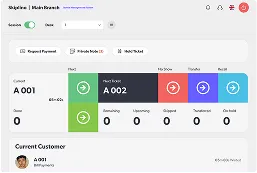
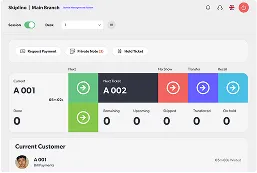
Here is one concrete, non-promotional example of the mechanics. When a customer joins a Skiplino queue line — via a branch kiosk, a web link, or the mobile app — they receive a live digital ticket. Behind the counter, agents see the full line, average handling times, and which service each customer needs, so they can pull the right customer at the right moment. The customer, meanwhile, watches their position count down on their phone and gets a notification to return shortly before their turn. The physical line effectively disappears; the order and fairness of the queue line stay perfectly intact.
Because every ticket is logged, managers get analytics they could never gather from a physical line — real wait times, peak hours, service durations per agent, and no-show rates — which feeds straight back into step 4 above.
Traditional queue line vs a queue management system
| Traditional queue line | Skiplino queue management system |
|---|---|
| Customers stand and wait with no visibility | Customers hold their place remotely and track it live |
| No data on wait times or peaks | Full analytics: waits, peaks, agent performance |
| Staffing is guesswork | Staffing driven by real demand data |
| No-shows waste slots | Automatic reminders and self-rescheduling |
| Order can feel unfair | Transparent, first-come-first-served ordering |
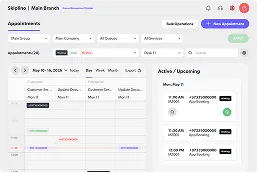
Explore how it works on our queue management system page, see the appointment booking tools, or try the mobile queue app.
Frequently asked questions
What is a queue line?
A queue line is an ordered line of people or tasks waiting to be served in the order they arrived. It can be physical, virtual, or managed from a mobile device.
Is it “queue line”, “que line”, or “cue line”?
“Queue line” is correct. “Que” is not standard English for a line, and “cue” means a signal or prompt, not a line of people.
What are the types of queue line?
The three main types are physical (waiting on-site in person), virtual (holding a digital place via a kiosk or web link), and mobile (joining and tracking the line from a phone).
How can I reduce queue line wait times?
Measure your line, move waiting off the floor with a virtual or mobile queue, show real-time wait estimates, match staffing to demand, and reduce no-shows with reminders and self-rescheduling.
What is a queue management system?
It is software that organises a queue line digitally — issuing tickets, tracking positions in real time, notifying customers, and giving managers analytics on wait times and staffing.
Does a queue line still exist with virtual queueing?
Yes. The order and fairness of the queue line remain; only the physical standing-in-line part is removed, because customers hold their place digitally.
Turn your queue line into an experience customers remember
A queue line is unavoidable when demand is healthy — but a frustrating one is entirely optional. Give customers their time back, make the wait visible and fair, and you turn a weak point into a competitive advantage.
Skip the line with Skiplino, the queue management system that makes waiting effortless for you and your customers. Start your free trial today.