The ROI of Implementing a Digital Queue Management System
3 Jun 2026
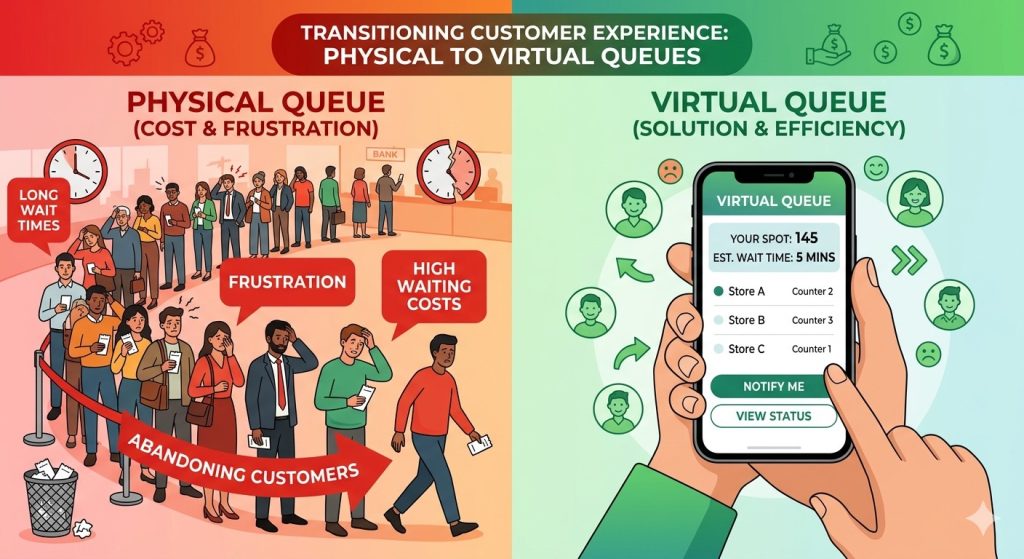
Every customer who walks out of a queue before being served represents direct, quantifiable revenue loss. According to research published in SAGE Open Medicine, unmanaged wait times don’t just frustrate customers — they measurably degrade satisfaction scores and drive abandonment across every service environment from emergency departments to retail branches. The business case for a digital queue management system is no longer theoretical. It is built from auditable KPIs, documented payback periods, and industry-specific performance data that justify the investment before the first ticket is issued.
This article provides a complete ROI framework: what costs go in, what gains come out, which KPIs to track, how long before you break even, and what the data looks like across healthcare, retail, restaurants, banking, and government.
The ROI Framework: Cost Inputs vs. Measurable Gains
A sound ROI model for queue management has two columns. On the cost side: software subscription or license fees, hardware (kiosks, tablets, digital signage), implementation and integration work, staff training, and ongoing support. On the gain side: recovered revenue from reduced walkouts, increased throughput, lower labor costs through better staff utilization, fewer service-recovery interactions, and improved customer lifetime value through higher satisfaction scores.
The calculation itself is straightforward:
ROI % = (Annual gains − Annual total costs) / Annual total costs × 100
Payback period (months) = Initial investment / Monthly net benefit
To make this concrete: if a single branch location loses 15 customers per day to queue abandonment, and each customer represents $50 in gross margin, that is $750 in daily lost revenue — approximately $225,000 per year on a 300-day operating calendar. A queue management deployment costing $30,000 annually fully loaded returns a net benefit of $195,000 in the first year from abandonment recovery alone, before accounting for throughput gains or labor efficiency. According to BreakingAC’s 2026 analysis of queue management ROI, this abandonment-to-revenue-loss model is one of the most underestimated components of the business case operators build.
Measurable KPIs: The Five Numbers That Define Your Return
Not every metric deserves equal weight in an ROI conversation. The KPIs that translate most directly into financial outcomes are:
- Average wait time. The single most cited operational metric. Reductions here correlate directly with abandonment reduction and satisfaction improvement. Wavetec’s 2024 analytics benchmarking guide identifies average wait time as the foundational KPI from which most downstream benefits flow.
- Abandonment rate. The percentage of customers who join a queue and leave before being served. Reducing this by even 10 percentage points in a high-traffic environment can recover tens of thousands in annual revenue.
- Throughput. Customers served per hour per agent or per location. Throughput improvements mean more revenue capacity without adding headcount — a direct labor efficiency gain.
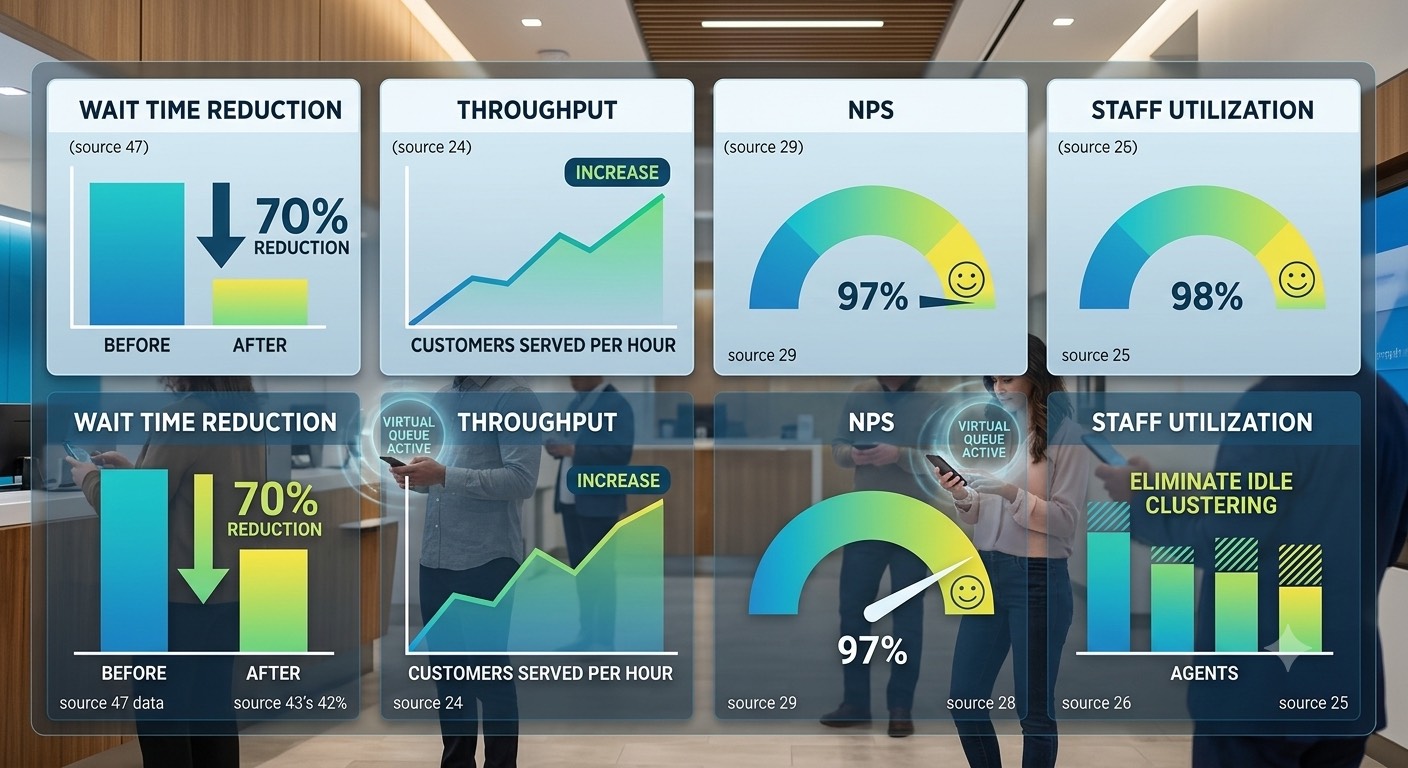
- Staff utilization. The ratio of active service time to total shift time per agent. Digital queue routing eliminates idle clustering at some counters while others are overwhelmed, improving utilization rates across the team.
- Net Promoter Score (NPS) and customer satisfaction. Soft in appearance, but measurable and consequential. Higher NPS correlates with repeat visit rates and referral behavior, both of which have clear revenue implications. According to research cited by MRI Software, queue management implementations in retail have achieved customer satisfaction improvements of up to 20%, with some environments reaching 97% satisfaction ratings post-deployment.
Payback Period Benchmarks by Environment
Payback timelines vary by daily customer volume, average transaction value, and baseline abandonment rate, but industry evidence supports the following ranges:
- High-traffic retail and telecom branches: 3–9 months
- Banking and financial services branches: 4–8 months
- Healthcare outpatient registration and emergency departments: 6–12 months
- Government and citizen services: 6–18 months
- Restaurants and hospitality: 3–12 months
These ranges assume modest abandonment recovery and moderate throughput improvement. In environments where pre-implementation wait times are severely elevated, payback compresses significantly. The key variable is volume: the more customers a location processes daily, the faster even small per-customer improvements accumulate into meaningful financial returns.
Industry Data: What the Numbers Look Like in Practice
The ROI case strengthens considerably when reviewed against specific industry evidence rather than generalized claims.
Healthcare. A peer-reviewed study published in SAGE Open Medicine measured the impact of a queue management system in an emergency department waiting room. Patients in the intervention group waited an average of 15.5 minutes compared to 27.03 minutes in the control group — a reduction of more than 42%. Perceived wait time dropped even more sharply, from 32.8 minutes to 11.9 minutes. Both actual and perceived wait time reductions drove statistically significant satisfaction improvements. In healthcare, where patient experience scores influence reimbursement and reputation, this level of improvement carries direct financial weight.
Retail. MRI Software’s 2024 analysis of queue management strategies in retail environments found that modern systems can reduce wait times by up to 70% and increase customer satisfaction by up to 20%. For high-footfall retail, those improvements translate into measurable conversion rate gains and reduced loss from customers who abandon purchase intent when queues feel unmanaged.
Restaurants and hospitality. Virtual queuing deployments in restaurant environments produced a 24.7% reduction in complaints about wait times and a 10.8% increase in overall customer satisfaction, according to data compiled by Q-nomy. In the restaurant sector, where guest experience directly drives review scores and return visits, those satisfaction gains carry substantial revenue implications.
Government and public services. Qminder’s ROI analysis highlights that public-sector deployments yield returns not only through cost reduction but through improved service predictability and citizen satisfaction — metrics that matter for agency performance assessments and public trust even where revenue is not the primary measure.
Soft ROI: Brand Reputation and Employee Satisfaction
The quantifiable metrics tell most of the story, but two additional dimensions consistently emerge in post-deployment assessments.
Brand reputation. Shorter, better-communicated wait times reduce frustrated reviews and increase positive word-of-mouth. In industries where public reviews directly influence foot traffic — retail, healthcare, hospitality — improvements in queue experience show up in ratings within weeks of deployment. The peer-reviewed emergency department study cited earlier demonstrates the direct link between wait time management and patient-reported experience: when actual and perceived wait times fall together, satisfaction scores rise significantly.
Employee satisfaction. Frontline staff working in chaotic, unmanaged queue environments face disproportionate complaint volume, repeated explanations of delays, and the operational stress of managing crowd buildup manually. Queue management systems redistribute that burden to the platform. Staff spend less time managing crowd dynamics and more time delivering the service they were hired for. Lower burnout, lower turnover, and higher engagement are consistent outcomes in environments where structured queue management replaces ad hoc line management — all of which reduce recruitment and training costs over time.
How to Build Your Business Case Before You Invest
Before approaching budget approval for a queue management deployment, gather four data points from your current operation:
- Daily customer volume and the percentage who abandon before service
- Average revenue or margin per completed transaction
- Current average wait time and service time per agent
- Fully loaded annual labor cost for staff assigned to queue-adjacent tasks
With these inputs, you can calculate your abandonment revenue loss, your theoretical throughput ceiling, and your labor efficiency opportunity. Compare these against the software subscription cost, hardware investment, and implementation timeline for your shortlisted vendors. The ROI typically becomes self-evident within the first pass of the model.
For benchmarking, platforms like Waitwhile and WaitWell offer virtual queuing functionality suited to smaller or single-location deployments. Qminder provides solid analytics reporting and HIPAA-ready compliance for healthcare environments. Qmatic remains the established choice for organizations requiring printer-based physical ticket infrastructure. Wavetec serves environments with extensive self-service kiosk requirements. These platforms address specific operational scenarios with varying depth of analytics and integration capability.
Why Skiplino Delivers the Strongest ROI Across Industries
For organizations that need comprehensive, measurable ROI from day one, Skiplino offers a combination of capabilities that directly maps to every line item in the ROI framework above.
Skiplino’s mobile-first virtual queuing eliminates physical line formation entirely, addressing abandonment at its root. Customers join queues remotely, receive real-time wait visibility through the mobile app, and return only when their service slot approaches — the mechanism that drives the platform’s documented 75% wait time reduction and 80% no-show reduction for scheduled appointments.
The real-time analytics dashboard tracks the five ROI-critical KPIs — wait time, abandonment, throughput, staff utilization, and satisfaction — in a single interface, giving managers the data they need to optimize staffing levels and eliminate bottlenecks before they compound. According to Skiplino’s own analytics benchmarking research, these insights translate directly into operational cost reductions of up to 30%.
Centralized multi-location management means that organizations running multiple branches pay one subscription to monitor and optimize performance across every location simultaneously — a structural advantage over per-location pricing models that penalize growth.
The Virtual Branch feature extends ROI further by enabling remote service delivery through integrated video calling, reducing the physical footprint required to serve customers without reducing service quality.
Skiplino deploys in under 10 minutes with zero technical configuration required, compressing the payback period by eliminating lengthy implementation cycles. For high-volume environments where every week of delay represents measurable revenue loss, that implementation speed is itself a financial differentiator.
If you are ready to model the ROI for your specific operation, explore Skiplino’s queue management platform or start your free trial to see the performance data for yourself.
Latest

Similar Reads

![Understanding a Visitor Management System [Step-By-Step Guide]](https://5012494.fs1.hubspotusercontent-na1.net/hub/5012494/hubfs/A-Guide-To-Visitor-Management-System.jpg "Understanding a Visitor Management System [Step-By-Step Guide]")

All Rights Reserved @2026 Skiplino Technologies WLL.


Hi!
What are you planning to do?