Queue Management for Hospitals: Reducing Patient Wait Times and Improving Care
2 Jun 2026
The average U.S. patient now waits about 31 days for a new appointment. In emergency departments, median waits can stretch to 2 hours and 42 minutes, and busy periods often push total visit time well beyond that. Long waits do more than frustrate patients. They lower satisfaction, weaken HCAHPS performance, increase reimbursement pressure, and raise the risk that patients will leave before receiving care. For hospital leaders, wait-time management is no longer a service improvement. It is a clinical, operational, and financial priority.
This article explains why hospital queue management matters, how wait times affect patient experience and revenue, and which solutions can deliver measurable improvement. It also shows how a modern, patient-friendly platform can help hospitals reduce delays, improve flow, and protect both care quality and brand reputation.
The Scale of the Wait-Time Problem in U.S. Hospitals
The scale of the access problem is hard to ignore. QueueAway and other industry sources place average new-patient appointment waits at roughly 31 days in many U.S. markets. Emergency departments face a related challenge: patients often wait too long for treatment spaces, inpatient beds, or provider evaluation, which creates backups that frontline staff cannot solve through effort alone.
Outpatient settings face the same pressure. Long appointment delays slow diagnosis, reduce patient confidence, and send demand to competitors or urgent care alternatives. Better scheduling can change that quickly. In a Mayo Clinic study of an automated waitlist, 24.6% of appointment offers were accepted, and accepted visits moved forward by an average of 22.6 days. That improvement came from smarter scheduling, not from adding more providers.
How Wait Times Drive HCAHPS Scores — and CMS Reimbursement
Patient experience directly affects hospital performance. CMS uses HCAHPS as the national standard for measuring inpatient experience, and those scores contribute to payment through the Hospital Value-Based Purchasing program. AHRQ supports the broader CAHPS framework across care settings. In short, patient experience is measurable, public, and financially meaningful.
When patients wait too long, they do not separate that delay from the rest of their care. A slow check-in, a delayed nurse response, or poor visibility into next steps can shape their entire perception of the visit. That makes queue management more than an operations issue. It becomes a patient-experience strategy and a practical way to protect reimbursement.
The operational implication is direct: improving patient flow is not only a capacity issue — it is a reimbursement protection strategy.
Left-Without-Being-Seen Rates, Missed Appointments, and the Clinical Cost of Waiting
Long waits can also create direct clinical risk. One of the clearest indicators is the left-without-being-seen rate. When patients leave before a medical evaluation, hospitals face lost volume, delayed diagnosis, and a higher chance that the patient will return in worse condition.
Recent research shows why this matters. A 2025 study in the Joint Commission Journal on Quality and Patient Safety found that patients who left without being seen were more likely to return, require admission, and die within 30 days than those who were evaluated and discharged. JAMA Network Open also reported that LWBS rates in California hospitals rose to 3.4% in 2022 before easing to 2.6% by 2024, with some hospitals approaching 10% at the 95th percentile. These are not minor leaks in performance. They are visible signs of access failure.
Delays also trigger missed appointments, no-shows, and inefficient schedules. That creates a costly cycle: providers lose productive time, patients lose trust, and the organisation appears harder to access than it really is. Strong queue management helps break that cycle with automated waitlists, real-time slot release, and self-service scheduling.
The Clinical Evidence for Queue Management Interventions
Why communication matters as much as speed
Queue management improves more than raw throughput. A peer-reviewed study indexed in PMC found that a structured queue system reduced actual waiting time and sharply reduced perceived waiting time. That distinction matters. When patients receive updates, understand what comes next, and feel acknowledged, they usually report a better experience even before total wait time falls dramatically.
What modern platforms can realistically deliver
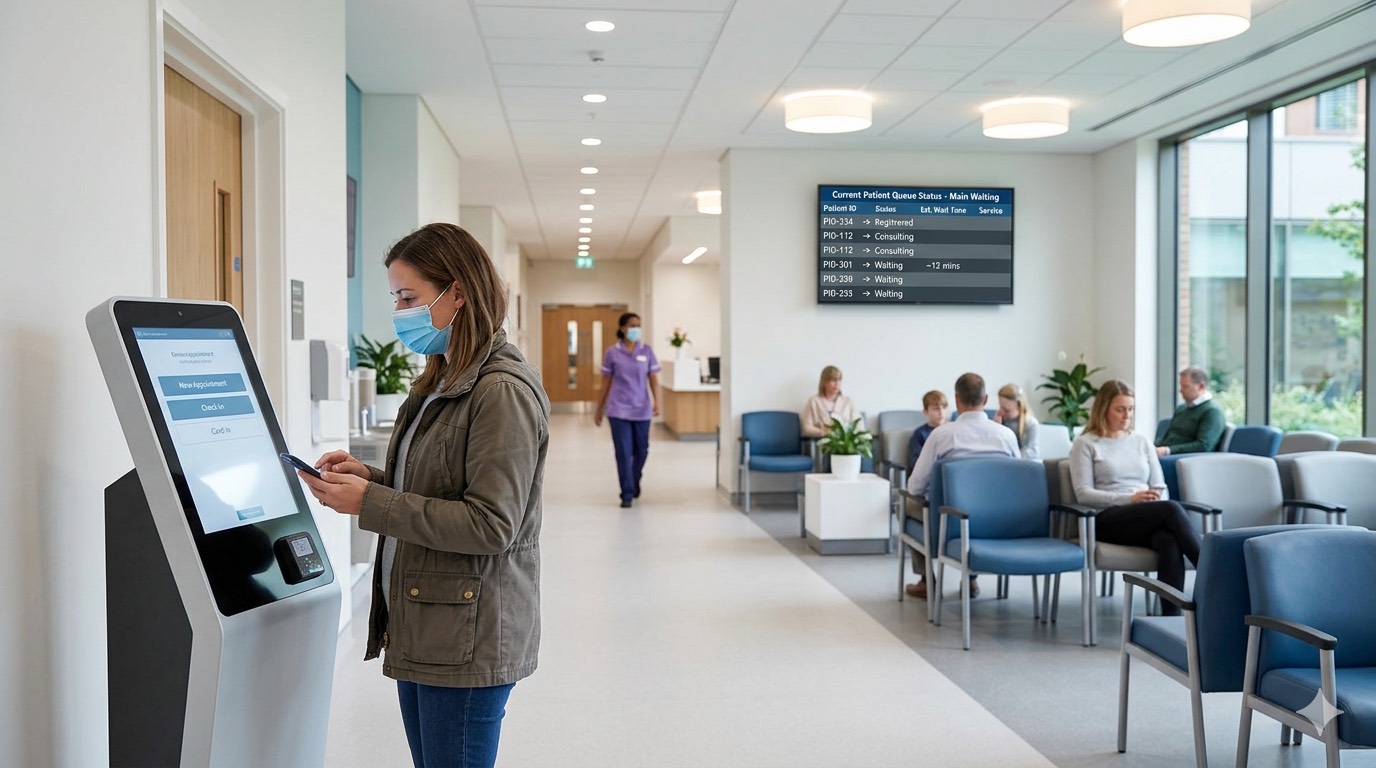
Modern queue platforms help hospitals reduce friction quickly. They support virtual queuing, real-time updates, and triage visibility without requiring major capital expansion. For leaders under pressure to improve access, that makes queue technology one of the fastest ways to strengthen patient flow, reduce crowding, and improve satisfaction at scale.
Operational Solutions: Virtual Queuing, Appointment Optimization, and Triage Workflows
Three categories of intervention account for the majority of measurable wait-time improvement in hospital and outpatient settings.
Virtual queuing eliminates the physical waiting room bottleneck by allowing patients to join a queue remotely via mobile device, receive real-time position updates, and arrive at the facility when their slot is genuinely ready. This reduces lobby crowding, lowers LWBS risk for patients who would otherwise leave after seeing a packed waiting room, and enables clinical staff to prepare for the next patient before they physically arrive.
Appointment optimization addresses the access problem upstream. Automated waitlists, intelligent slot release, and self-service rescheduling tools allow health systems to fill cancellations within hours rather than days. The Mayo Clinic data cited earlier demonstrates that this approach alone can advance patient access by more than three weeks — a result that directly improves new-patient satisfaction and reduces the 30-day wait benchmark.
Triage workflow integration connects queue data to clinical decision-making. When triage nurses and ED charge clinicians have real-time visibility into queue depth, estimated wait times by acuity level, and historical volume patterns, they can make better decisions about fast-track activation, provider-in-triage deployment, and staffing adjustments. Queue analytics become a clinical tool, not just an administrative one.
How Skiplino Addresses Hospital Queue Management
Designed for better patient experience
Skiplino is built for organisations that need faster, more organised patient flow. Its platform combines real-time queue visibility, mobile check-in, virtual queuing, appointment scheduling, automated reminders, and centralised analytics. Together, these capabilities help hospitals reduce waiting, improve communication, and create a smoother patient journey from arrival to service completion.
Built to reduce pressure on staff and space
With mobile-first check-in and live queue updates, patients can join remotely and arrive when their turn is closer. That reduces waiting-room congestion, lowers frustration, and helps staff manage demand more calmly. It also improves the patient’s sense of control, which is critical when expectations are already strained.
Skiplino also gives managers the data they need to act. Its analytics dashboard shows wait times, service durations, staff productivity, and peak-volume patterns across locations. That visibility helps leaders make better staffing, scheduling, and triage decisions instead of reacting after delays have already escalated.
Stronger access without adding complexity
On the scheduling side, automated reminders and smarter slot management help reduce no-shows and make better use of provider capacity. That means faster access for patients and a more reliable schedule for teams. For organisations working to reduce appointment delays, this is where operational efficiency turns into a competitive advantage.
Many queue tools can improve a single touchpoint. Skiplino stands out by combining rapid deployment, mobile-first design, virtual queuing, and multi-location management in one platform. That makes it especially valuable for hospital groups and outpatient networks that need consistency across departments, clinics, and service points.
For hospital leaders, the message is clear: reducing wait times improves patient experience, protects revenue, and supports better care delivery. The technology to make that happen already exists. The real opportunity is to implement it before delays become an even bigger clinical and financial burden.
Ready to improve patient flow and reduce wait times? Explore Skiplino’s healthcare queue management capabilities or book a demo to see how the platform can support your hospital’s patient experience, operational goals, and growth plans.
Latest
Similar Reads



All Rights Reserved @2026 Skiplino Technologies WLL.


Hi!
What are you planning to do?