How Queue Management Systems Use Customer Feedback to Improve Service

12 May 2026
Real-time satisfaction data collected at the queue level gives businesses the earliest warning system available — and the fastest path to service recovery.
| 📋 What You’ll Learn ✔ Why feedback collected at the queue level is more actionable than general surveys ✔ How to turn post-service feedback into branch-level performance improvements ✔ The measurable ROI: satisfaction scores, churn reduction, and revenue impact ✔ How Skiplino integrates real-time feedback collection into your queue management workflow |
Most businesses find out a customer was unhappy too late — in a review, a churn report, or a complaint. But the moment a service experience goes wrong is not in the CRM. It is in the queue.
Queue management systems like Skiplino sit at exactly that inflection point: after the wait, at the moment of service, before the customer walks out the door. That proximity to the experience makes real-time feedback collected through queue infrastructure categorically more valuable than a generic satisfaction survey sent three days later.
This article explains what queue-linked customer feedback is, how it works in practice across banking, healthcare, retail, and government, and what the measurable outcomes look like.
1. Why Feedback Collected at the Queue Level Is Different
Generic feedback tools measure sentiment in aggregate. Queue-linked feedback measures it at the transaction level — by branch, by service type, by staff member, and by time of day.
This distinction matters because it changes what you can actually do with the data:
- A low satisfaction score on a Monday morning tells you nothing actionable.
- A low satisfaction score on a Monday morning at Branch 7, linked to a 22-minute wait for a specific service type, tells you exactly where to intervene.
Queue management systems make the second type of insight possible by attaching feedback collection to a structured service event — not a vague recall of a customer’s week.
| Quick Answer If you’re looking for ways to improve customer satisfaction scores in a branch or service environment, the fastest lever is collecting feedback immediately after the queue experience — before the customer has left — and routing it to the right manager in real time. |
2. The Case for Instant Feedback: By the Numbers
The business case for real-time feedback is well-documented. Here is a summary of the key metrics from published research:
| Metric | Impact |
| Customer satisfaction lift | +25% (real-time vs. periodic feedback) |
| Churn reduction with instant response | Up to 20% |
| Retention increase from post-queue feedback | +30% within 6 months |
| Reduction in support ticket volume | 25% via proactive resolution |
| ROI of real-time feedback programs | 4:1 return on investment |
| Customers who prefer brands that act on feedback | 77% view brands more favourably |
The pattern is consistent: the closer the feedback loop is to the service moment, the higher the business impact. A monthly survey cannot capture what a post-queue prompt can.
3. The Hidden Problem: Most Dissatisfied Customers Say Nothing
Only 1 in 26 dissatisfied customers will raise a complaint. The other 25 leave quietly — and often do not return. This is the silent churn problem that periodic feedback mechanisms structurally cannot address.
Real-time queue feedback changes the economics of complaint capture. When a customer is prompted immediately after their service interaction — while they are still on-site or within the first minute of departure — the response rate and candour are both significantly higher.
More importantly, the feedback arrives while there is still time to act. A manager who receives an alert about a poor service interaction within minutes can:
- Reach the customer before they leave the premises
- Identify whether the issue was wait-time related or service-quality related
- Log the incident and flag it for coaching or process review
- Prevent the experience from becoming a negative public review
This is service recovery at the queue level — and it is only possible when feedback is embedded into the queue management workflow.
4. How Skiplino Integrates Feedback Into Queue Management
Skiplino is a queue management platform used by banks, hospitals, government offices, and retailers across the Middle East and beyond. Its feedback module is built into the service journey — not bolted on as a separate tool.
How the feedback loop works:
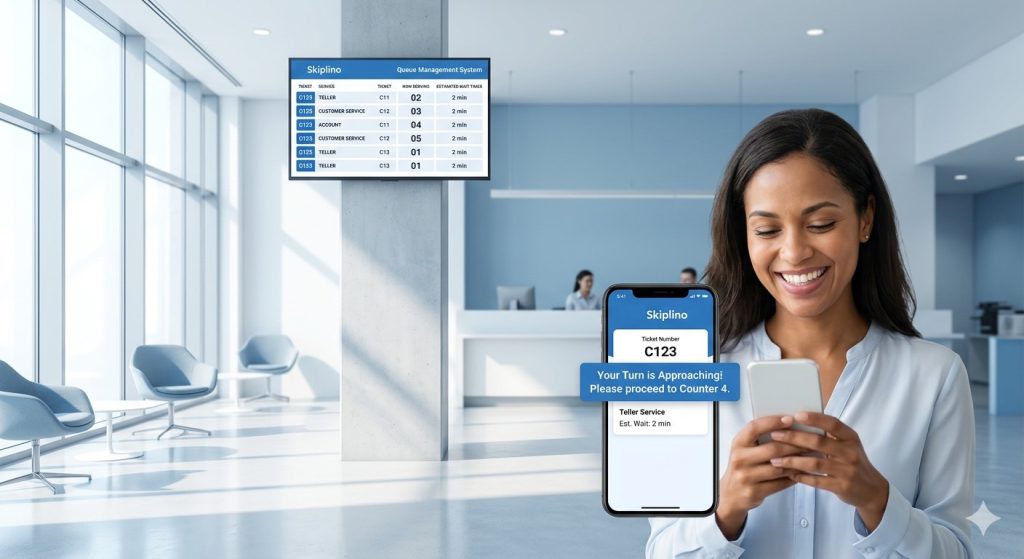
- Customer joins the queue digitally (via app, kiosk, or SMS) and receives a ticket number
- After their service is complete, a satisfaction prompt is sent automatically via app notification or kiosk display
- The rating (typically a 1–5 or emoji-based scale) is tagged to: the branch, the service type, the agent, and the time of interaction
- Real-time alerts are triggered for scores below a defined threshold
- Managers view aggregated and per-transaction data in the Skiplino analytics dashboard
This integration means feedback is not a separate initiative that requires staff to remember to distribute — it is a native output of the queue workflow.
| Key Differentiator Unlike standalone survey tools, Skiplino’s feedback data is always linked to queue performance data — wait time, service duration, peak hours, and branch load. This makes it possible to correlate satisfaction scores with operational metrics and identify root causes, not just symptoms. |
5. Industry Applications: Queue Feedback in Practice
The following table shows how real-time queue feedback is applied across the industries Skiplino serves most frequently:
| Industry | Queue-linked Feedback Point | Skiplino Feature |
| Banking | Post-teller rating on transaction time | Real-time branch dashboard |
| Healthcare | Post-consultation wait satisfaction | Smart notifications + kiosk survey |
| Government | Service quality per visit type | Analytics by service category |
| Retail | Checkout speed & staff helpfulness | Mobile app rating prompt at exit |
| Telecom | Resolution effectiveness score | Sentiment dashboard + escalation alert |
Banking
In branch banking, wait time is the primary driver of satisfaction variance. Skiplino’s real-time dashboard allows branch managers to monitor live queue length and satisfaction scores simultaneously — enabling same-day adjustments to staffing or service routing when scores drop.
Healthcare
In healthcare settings, patient experience is a regulated metric in many markets. Queue-linked feedback tied to consultation wait times gives clinic administrators the documentation and trend data needed to demonstrate compliance and improvement over time.
Government Services
Citizens interacting with government offices have limited alternatives — but their satisfaction scores directly affect institutional reputation. Queue feedback by service category helps identify which transaction types create the most friction, guiding process redesign priorities.
Retail
Checkout queue experience is one of the top drivers of retail abandonment. A post-checkout feedback prompt — particularly on mobile — captures real-time signals about whether a customer intends to return, which is a leading indicator of lifetime value.
6. Revenue Impact: Connecting Feedback to Business Outcomes
Customer satisfaction is not a soft metric. When queue feedback is collected systematically and acted on, the financial outcomes are measurable:
- A 5% increase in customer retention produces profit increases of between 25% and 95% (Harvard Business School research).
- Companies with real-time feedback mechanisms report a 4:1 ROI on their investment in feedback infrastructure.
- Businesses that respond to feedback in real time see 30% higher retention rates within six months.
- Support ticket volumes fall by 25% when frontline teams are empowered to resolve issues proactively — before they escalate.
The compounding effect is significant: reducing churn by even 5–10% in a service business with recurring customer relationships translates directly to top-line revenue, not just satisfaction scores.
7. Reputation Management: From Private Feedback to Public Perception
77% of customers say they view a brand more favourably when the brand asks for — and acts on — feedback. The inverse is also true: customers who feel unheard are significantly more likely to share negative experiences publicly.
Queue-integrated feedback creates a structured channel that captures dissatisfaction before it becomes a public review. When a Skiplino alert fires at a 1- or 2-star post-service rating, a manager can respond within the same visit — turning a potential detractor into a recovered customer.
This is not just customer service. It is reputation infrastructure.
8. Setting Up a Queue Feedback System: What to Get Right
For organisations implementing queue-linked feedback for the first time, the following configuration decisions determine whether the system generates actionable data or noise:
- Timing: Prompt within 60 seconds of service completion — not the next day.
- Brevity: One primary question with an optional open-text field. Longer surveys depress response rates.
- Routing: Define clear escalation rules — which scores trigger an alert, to whom, and with what SLA for response.
- Granularity: Tag every response to at minimum: branch, service type, and timestamp. Without this, you have sentiment but no diagnosis.
- Benchmarking: Track scores over time per location, not just as a global average. A single low-performing branch can mask improvement elsewhere.
Skiplino’s implementation team works with clients to configure these parameters at setup — so the system is generating usable intelligence from day one.
Conclusion
Instant customer feedback is not a standalone CX initiative. It is most effective — and most actionable — when it is embedded directly into the queue management workflow, where it can be tagged to a specific service event, routed to the right person in real time, and connected to the operational data that explains why a customer was satisfied or dissatisfied.
That is what separates queue-integrated feedback from a generic survey tool. And it is what makes the difference between knowing you have a service problem and knowing exactly where it is, when it happens, and who needs to fix it.
| Ready to implement real-time queue feedback? Skiplino’s queue management platform includes built-in feedback collection, real-time alerts, and branch-level analytics — all configured for your industry. Book a demo now or start a free trial. |
Latest

Similar Reads



All Rights Reserved @2026 Skiplino Technologies WLL.


Hi!
What are you planning to do?