Top 7 Queue Management Systems With Powerful Data Analytics (2026)

10 May 2026
As businesses enter 2026, data-driven queue management systems (QMS) have become essential tools for optimizing service operations. These solutions combine real-time monitoring, analytics dashboards, and predictive insights to shorten wait times, reduce no-shows, and improve customer experiences. When evaluating the best queue systems, the focus has shifted toward platforms that do more than manage lines—they transform queue data into actionable intelligence.
This guide reviews seven leading queue management systems renowned for their powerful analytics and integration capabilities. From cloud-based flexibility to enterprise-grade reporting, each system brings unique strengths for different organizational needs.
Strategic Overview
A queue management system helps organizations monitor, control, and optimize customer flow across physical and virtual channels. The most powerful systems now include advanced analytics features such as real-time dashboards, predictive reporting, and staff performance measurement. These analytics tools turn queue data into insights that can drive service improvements, balance workforce demand, and deliver measurable ROI.
Each solution below has been evaluated for its analytics strength, integration potential, scalability, and usability to provide a clear view for decision-makers seeking the right fit.
Skiplino
Skiplino stands out as a cloud-based, analytics-driven platform built to manage multiple branches from a single dashboard. It centralizes queue and appointment data, giving managers full visibility into performance across locations.
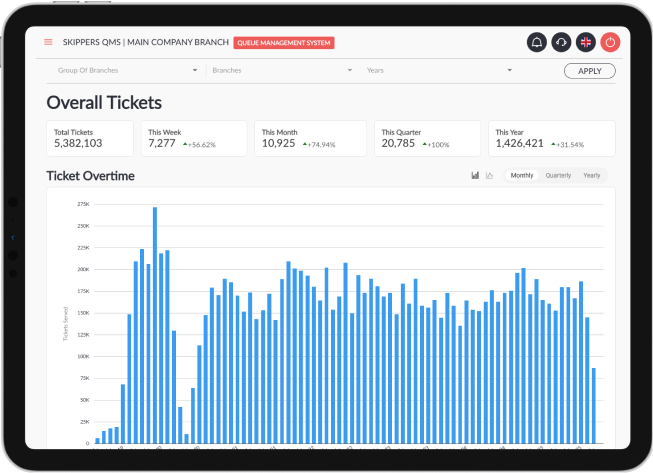
Supported by live dashboards, Skiplino monitors traffic flow, wait times, and agent productivity while collecting customer feedback after each interaction. Historical analytics reveal long-term trends and guide data-informed staffing and resource decisions.
Thanks to its open API, Skiplino integrates seamlessly with CRM, ERP, or BI tools for deeper analysis. These capabilities directly contribute to measurable outcomes—up to 75% shorter waits, 80% fewer no-shows, and a 97% customer satisfaction rate—making it a trusted benchmark for results-focused queue management.
WaitWell
WaitWell offers a unified queue and appointment solution that merges walk-in and scheduled flows under a single analytics view. Its dynamic dashboards track wait times and throughput, providing a clear picture of service demand and bottlenecks.
Reporting covers staff utilization and visitor trends, which is useful for small to mid-sized businesses seeking affordable, actionable insights. With mobile check-in and digital signage, WaitWell maintains operational efficiency while scaling analytics without enterprise-level setup.
Qminder
Qminder focuses on kiosk-based environments that need detailed performance tracking. Its analytics suite suits service centers, banks, and public offices requiring structured, role-level insights.
The platform delivers visual dashboards displaying queue length, average handling time per staff member, and customer satisfaction metrics gathered from feedback stations.
While its hardware-centric approach and premium pricing may not fit every organization, Qminder serves users who prioritize agent-level analytics and front-desk efficiency.
Quick Comparison:
- Pricing: Premium tiered plans
- Analytics depth: Advanced
- Hardware requirement: Yes (kiosk integration)
Waitwhile
Waitwhile is known for simplicity and speed of implementation. It provides lightweight analytics suited to retail, hospitality, and service-focused startups.
Its dashboards display live queue statuses, service-time averages, and automated reminder performance. The platform supports hybrid workflows for both appointments and walk-ins and offers a free tier for basic use.
| Core Analytics Feature | Description |
|---|---|
| Real-time wait tracking | Monitors queue progress dynamically |
| Average service time | Measures staff performance and efficiency |
| Notification analytics | Tracks message delivery and impact |
Waitwhile’s approachable interface and tiered pricing make it suitable for growing businesses looking for manageable, data-informed operations.
Qmatic
Qmatic provides enterprise-grade capabilities and emphasizes customer journey analytics—the detailed mapping of the service experience from entry to exit.
By combining historical data with live operational KPIs, Qmatic enables organizations to identify causes of congestion or service drop-offs. Its analytics extend beyond queue tracking to include performance across multiple channels, supporting more accurate resource allocation.
However, these capabilities often require greater setup complexity and hardware investment, making Qmatic best suited for large-scale banks, governments, and healthcare networks.
QLess
QLess pioneered virtual queuing and remains established in combining digital and in-person waitlist analytics. Its real-time dashboards and predictive reports identify service peaks so teams can anticipate demand.
Analytics modules capture appointment adherence, staff efficiency, and engagement levels across institutional settings. The system’s flexibility supports integration within enterprise environments, offering strong appeal for organizations managing large customer volumes.
Wavetec
Wavetec delivers an integrated analytics framework designed for high-volume service operations, particularly in finance and telecommunications. Its platform consolidates data from in-person, mobile, and web channels into unified performance reports.
Key metrics include branch-level throughput comparisons, agent utilization, and volume heatmaps that visualize customer flow patterns.
While pricing is tailored per project, Wavetec fits organizations managing complex networks that require full multi-channel analytics visibility.
How to Choose a Queue Management System With Strong Analytics
Selecting the right queue management system begins with clarifying business goals and operational scope. Determine whether your organization manages a single branch or multiple sites, and whether you handle physical, virtual, or hybrid queues.
Then, assess each candidate on analytics sophistication, reporting options, and integration flexibility. A practical decision chart might include:
- Scale: Single-site or enterprise deployment
- Channels supported: In-person, virtual, or hybrid workflows
- Integration depth: APIs for CRM, BI, or data export
This structured approach simplifies system evaluation and aligns technical capabilities with measurable business outcomes.
Key Analytics Features to Look for in Queue Management Software
Queue analytics transform operational data into improvement opportunities. These are the most critical features to prioritize:
- Real-time dashboards: Graphical views displaying live wait times, queue lengths, and service flow metrics.
- Performance KPIs: Quantitative measures such as average service time, queue abandonment, and agent productivity.
- Historical reporting: Data archives revealing trends and supporting predictive staffing.
- Feedback tracking: Post-visit rating tools that connect customer experience with performance metrics.
| System | Real-Time Dashboards | Historical Reports | Custom Reporting | Multi-Location Support |
|---|---|---|---|---|
| Skiplino | ✔ | ✔ | ✔ | ✔ |
| WaitWell | ✔ | ✔ | Partial | ✔ |
| Qminder | ✔ | ✔ | ✔ | Optional |
| Waitwhile | ✔ | Partial | Partial | ✔ |
| Qmatic | ✔ | ✔ | ✔ | ✔ |
| QLess | ✔ | ✔ | ✔ | ✔ |
| Wavetec | ✔ | ✔ | ✔ | ✔ |
Benefits of Data-Driven Queue Management Systems
Analytics-enabled queue platforms give organizations precise control over service flow and team performance. Businesses often see shorter wait times, better staff allocation, fewer missed appointments, and higher satisfaction levels.
A data-driven queue management system applies real-time and historical analytics to monitor and optimize customer flow. These insights reduce bottlenecks and support long-term performance, efficiency, and productivity gains.
Integration and Scalability Considerations for Analytics-Enabled Systems
Integration connects queue data to the broader business ecosystem, ensuring that analytics inform day-to-day operations. APIs allow metrics to flow directly into CRM, ERP, or BI dashboards for unified visibility.
To ensure future scalability, evaluate systems for:
- API and data export capabilities
- Centralized multi-location control
- Cloud-based flexibility
- Verified reporting accuracy before deployment
These precautions ensure the platform’s analytics scale alongside operational growth. Skiplino, for example, offers an API-first architecture that adapts easily as businesses expand footprints or data systems.
Frequently Asked Questions
What are the best analytics features in queue management systems?
The best systems, such as Skiplino, include live dashboards, performance KPIs, and API-enabled reporting for actionable insights.
How does queue data analytics improve customer experience and operations?
It delivers faster service, informed staffing, and predictive insights that reduce wait times and improve satisfaction.
Are cloud-based queue management systems more scalable for data insights?
Yes. Cloud solutions like Skiplino provide real-time analytics across branches, supporting visibility and consistent performance.
What should businesses evaluate when integrating queue systems with CRM or BI tools?
Confirm that the platform offers reliable APIs and stable data exports that align with your analytics ecosystem.
How can queue analytics reduce wait times and no-shows effectively?
By analyzing historical demand and automating reminders, analytics help minimize idle periods and customer drop-offs. Skiplino uses these insights to consistently improve service efficiency.
Latest

Similar Reads


![Choosing The Best Queue Management Software [Comparative Guide]](https://5012494.fs1.hubspotusercontent-na1.net/hub/5012494/hubfs/queue-management-system.jpg "Choosing The Best Queue Management Software [Comparative Guide]")
All Rights Reserved @2026 Skiplino Technologies WLL.


Hi!
What are you planning to do?