Bank Queue Management: How to Reduce Wait Times, Improve Customer Experience, and Increase Branch Efficiency
25 May 2026
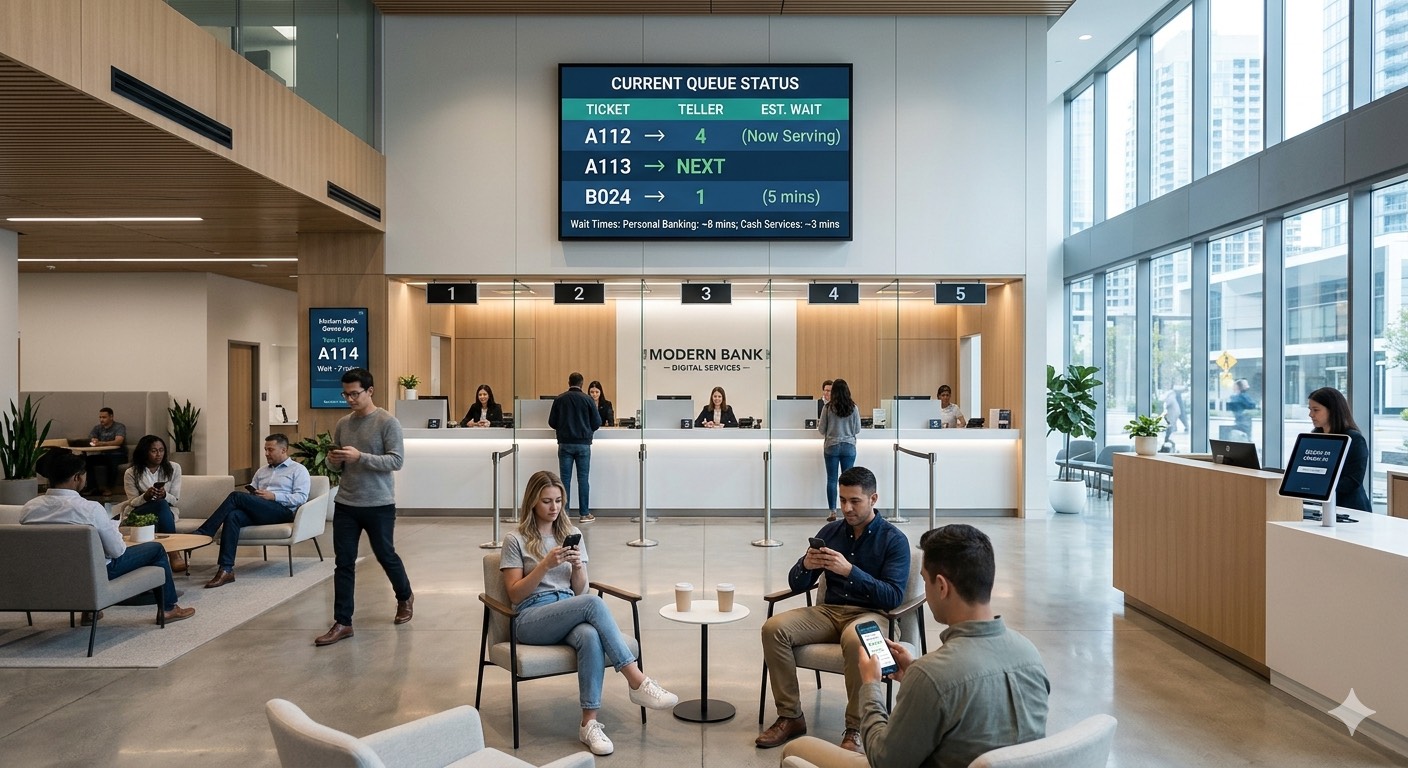
Bank queue management helps financial institutions reduce wait times, improve customer satisfaction, and run branches more efficiently. For banks competing on both service quality and operational performance, the branch experience has become a direct driver of retention, revenue, and reputation. According to a 2024 consumer survey by Waitwhile, nearly 70% of consumers prefer booking an appointment instead of waiting in a physical line. That shift creates a clear opportunity for banks to modernise service delivery with virtual queuing, appointment scheduling, and mobile check-in.
In this guide, you’ll learn why long waits damage branch performance, how digital queue systems improve banking operations, and what to look for in a bank queue management solution built for compliance, customer experience, and growth.
Why Bank Branches Struggle with Peak-Hour Congestion
Branch foot traffic rarely spreads evenly across the day or week. Most retail bank branches face predictable congestion at lunch, on Friday afternoons, and after public holidays or payroll cycles. Without dynamic queue management, even well-staffed branches can produce long wait times during these periods. During quieter hours, those same branches may be overstaffed.
This creates two problems. Customers who arrive at peak times face crowded lobbies and uncertain waits. At the same time, branches carry staffing costs designed for short peak periods. Engageware’s analysis of hybrid branch banking highlights smart traffic analysis and queue visibility as the most effective ways to solve this imbalance. It recommends that banks track peak-hour patterns by branch and use appointment scheduling to spread walk-in demand across the day.
Digital queue systems help solve this issue at its source. Customers can check in remotely, receive live queue updates, and choose arrival windows that match real service capacity. As a result, peak-hour congestion eases. Branch operations become more predictable, staff are used more efficiently, and customers have a better experience without the need for extra headcount.
The Cost of Long Wait Times in Bank Branches
Customers are less willing to wait in a branch than many operations managers assume. Research cited by Wavetec’s banking queue management guide shows that 73% of customers would abandon an interaction if they had to wait more than five minutes. In a branch, abandonment means an incomplete transaction, a lost cross-sell opportunity, and a customer who may turn to a competitor or a digital channel instead.
The impact of repeated long waits grows over time. According to QueueHub’s queue management statistics research, 89% of customers are less likely to return after a long wait. That figure should change how banks view queue management. It is not just an operational expense; it is a retention tool with direct revenue impact.
The same research shows a wide performance gap between institutions. Top-quartile queue management performers retain 89% of customers, while bottom-quartile performers retain only 62%. That 27-point gap, driven by service flow quality, represents a major business risk for any retail banking network operating at scale.
How Queue Management Improves Customer Satisfaction and NPS in Banking
For many customers, branch visits are rare and usually reserved for complex needs such as opening accounts, discussing mortgages, or resolving disputes. Because these visits happen infrequently, the wait experience has an outsized effect on how customers judge the relationship. One long, disorganized wait can undo trust built over years.
The NPS data supports this clearly. According to QueueHub, businesses with excellent queue management systems achieve an average Net Promoter Score of 48, compared with 12 for businesses with poor queue systems. This 36-point gap is significant. It marks the difference between customers who recommend the bank and customers who discourage others from using it.
Operational improvements also drive measurable loyalty gains. The same source reports that cutting wait times by 20% increases customer satisfaction by 33% and repeat visits by 28%. In banking, where each customer relationship can span current accounts, savings, mortgages, and insurance, a 28% rise in repeat visits is a meaningful commercial result.
Best Bank Queue Management Features: Virtual Queuing, Appointments, and Mobile Check-In
The Waitwhile 2024 consumer survey found that 52% of consumers prefer virtual queues over physical lines. This has clear implications for branch design. Virtual queuing lets customers join remotely, track their position in real time, and arrive only when their turn is near. That reduces lobby crowding, lowers perceived wait times, and removes the stress of losing a place in line.
Appointment booking adds another layer of control. Pre-scheduled visits give branch managers better visibility into incoming demand and help staff prepare for complex transactions in advance. They also ensure that high-value or time-sensitive customers, such as mortgage applicants or business clients, receive focused service. Coconut Software’s analysis of digital queue management in banking describes a retail bank that cut customer wait times by 51% after moving to a digital queue system. It also reports a 15.55% year-over-year revenue increase at banks using digital check-in, appointment booking, and live service updates together.
Mobile check-in extends these benefits before customers even leave home or the office. Instead of joining a physical line on arrival, they can check in through an app or web link, receive a queue token, and get live SMS or push updates as their slot approaches. This turns the branch visit into a planned event with a more predictable duration.
Why Compliance and Privacy Matter in Bank Queue Management
Queue management in financial services carries compliance dimensions that do not apply equally in retail or hospitality settings. Customer data collected during check-in — identity, reason for visit, service history — must be handled within applicable data protection frameworks. Branch environments serving business banking, wealth management, or mortgage customers require additional discretion: a client arriving for a private banking consultation should not be visible in a shared lobby display alongside general teller queue numbers.
Digital queue systems address both concerns. Visit data is encrypted and access-controlled, supporting GDPR and comparable regulatory obligations. High-value or specialized service categories can be routed silently — the customer receives a mobile notification directing them to a specific area or adviser without their name or purpose appearing on a public display. Qminder’s bank queue management documentation outlines this capability as intelligent routing: matching customers to the right member of staff based on reason for visit, language preference, or relationship tier, improving both the service outcome and the customer’s sense of being recognized.
For compliance-sensitive institutions, this routing functionality also supports audit trails — digital records of service timestamps, staff assignments, and transaction categories that physical ticketing systems cannot produce with comparable accuracy.
How to Compare Bank Queue Management Solutions
Several established vendors serve the banking vertical, and each reflects a distinct philosophy. Qmatic, with four decades of hardware-first queue management, is the dominant choice for branches requiring physical ticket printers, dedicated kiosk infrastructure, and audio announcement systems. Its strength is scale and reliability in traditional branch environments; its constraint is deployment complexity and hardware dependency. Wavetec occupies similar territory — comprehensive kiosk and display infrastructure with strong self-service capabilities, well-suited to banks that require physical touchpoints throughout the lobby.
Qminder offers a lighter-weight, analytics-focused platform that performs well for smaller branch networks seeking rapid deployment, transparent subscription pricing, and detailed service analytics without extensive hardware investment. WaitWell handles hybrid operations efficiently — combining walk-in queue management with appointment scheduling in a single interface — making it a practical option for branches managing both categories simultaneously.
Where these platforms vary is in mobile-first capability, real-time customer communication depth, virtual branch functionality, and the ability to manage multi-location banking networks from a centralized dashboard. For banks whose branch transformation strategy extends beyond hardware modernization into genuine digital service delivery, those dimensions matter significantly.
Why Skiplino Is a Strong Queue Management Solution for Banks
Customer Experience Benefits
Skiplino’s queue management platform gives banks the tools they need to reduce wait times, improve branch flow, and deliver a more modern customer experience. Its core capabilities include real-time wait visibility, mobile check-in, virtual queuing, appointment scheduling, and centralized multi-location analytics. That makes it a practical option for banks that want faster deployment, lower lobby congestion, and better visibility across branch operations without relying on complex hardware.
From the customer’s perspective, the value is immediate. Customers can join a queue before they arrive, receive live wait-time updates, and time their visit more accurately. That means less frustration, fewer walkouts, and a branch experience that feels organised, efficient, and customer-friendly.
From the bank’s perspective, better queue visibility leads to better decisions. Skiplino’s analytics dashboard helps managers identify peak traffic windows, spot services that trigger abandonment, and allocate staff more effectively. The result is stronger branch performance, better resource planning, and a service model that supports both customer satisfaction and operational efficiency.
Operational Visibility and Control
Skiplino’s appointment booking feature helps banks turn high-value visits into better service outcomes. Advisers can prepare for mortgage consultations, account openings, and business banking discussions before the customer arrives. Its Virtual Branch capability also extends service beyond the lobby, supporting video-based interactions for customers who prefer remote assistance or cannot visit in person.
Appointments, Virtual Service, and Compliance
For banks operating across multiple locations, Skiplino provides a centralized view of branch activity, service demand, and customer flow. It also supports enterprise-grade security and GDPR compliance, which is critical for financial institutions that need to improve service without compromising privacy, governance, or control.
The commercial case for digital queue management is compelling. Banks that reduce waiting friction can improve retention, increase repeat visits, and strengthen brand perception at the branch level. For institutions investing in branch transformation, queue management is no longer a nice-to-have. It is a practical growth lever that connects customer experience, staff productivity, and revenue performance.
Frequently Asked Questions About Bank Queue Management
What is bank queue management?
Bank queue management is the process of organising customer flow in a branch using tools such as ticketing, virtual queues, appointment booking, and mobile check-in. Its goal is to reduce wait times, improve customer experience, and help staff manage demand more efficiently.
Why is queue management important for banks?
Queue management is important for banks because long waits increase abandonment, damage customer trust, and reduce branch efficiency. A strong queue system helps banks serve more customers smoothly while improving satisfaction, retention, and staff productivity.
How can banks reduce customer wait times?
Banks can reduce customer wait times by using virtual queuing, appointment scheduling, mobile check-in, and real-time traffic analytics. These tools help spread demand, prepare staff for complex visits, and reduce lobby congestion during peak hours.
What features should banks look for in a queue management system?
Banks should look for features such as virtual queues, appointment booking, mobile check-in, customer notifications, branch analytics, multi-location dashboards, and strong security controls. For financial institutions, compliance support and privacy safeguards are also essential.
To see how Skiplino performs in a financial services branch environment, explore Skiplino’s banking queue management capabilities or start a free trial to evaluate the platform against your branch’s specific traffic and compliance requirements.
Latest
Similar Reads



All Rights Reserved @2026 Skiplino Technologies WLL.


Hi!
What are you planning to do?