Queue Management Trends 2026: How AI Is Replacing the Waiting Line
19 May 2026
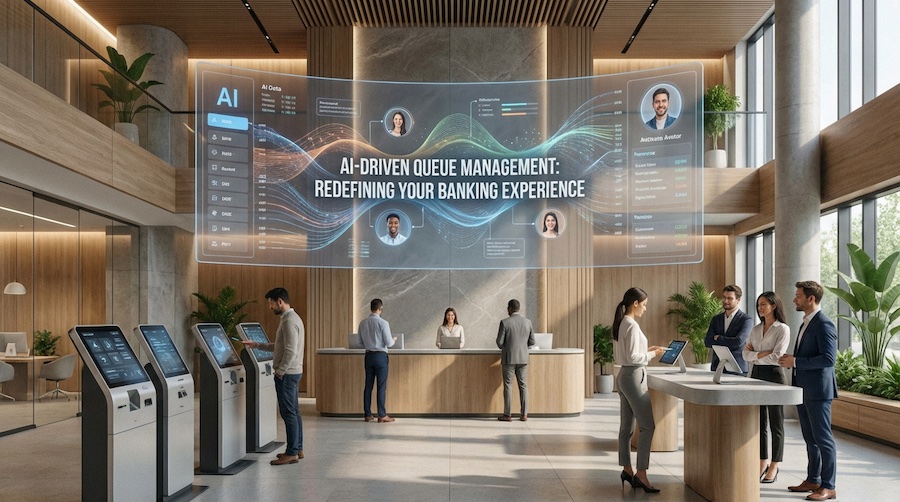
Queue management systems in 2026 use AI to predict demand, automate check-in, and surface real-time operational insights. They replace static, ticket-based systems that only respond after congestion has occurred. Banks, government agencies, retailers, and healthcare providers are shifting from reactive queue control to proactive customer flow management. The goal is no longer to manage the wait — it is to eliminate it.
This article covers the seven most significant queue management trends in 2026. Each section explains what the trend is, why it matters operationally, and what evidence supports it.
What Is a Data-Driven Queue Management System?
A data-driven queue management system collects real-time and historical data on customer arrivals, service durations, staff performance, and channel preferences. The system uses that data to automate scheduling decisions, trigger customer notifications, and generate dashboards that explain — not just display — what is happening across a branch or network. The core difference from traditional queuing: every decision draws on evidence rather than intuition or routine.
Trend 1 — AI-Powered Predictive Flow Modeling
How Predictive Modeling Works
Predictive flow modeling uses machine learning to forecast customer arrival rates for specific time slots. It trains on historical visit data, seasonal patterns, appointment records, and local event calendars. Managers receive a staffing recommendation hours or days before peak demand arrives — not in response to a queue that has already built up.
Traditional queue systems answer one question: how many people are waiting right now? Predictive systems answer a different one: how many people will arrive at 2:00 PM next Tuesday, and does current staffing cover it? Skiplino’s platform generates these forecasts at the branch level. It factors in historical patterns alongside real-time signal data.
The Operational Case
A 2023 McKinsey analysis of retail banking found that AI-driven workforce scheduling cut unplanned overtime by 18% and reduced customer-facing idle periods. The mechanism is simple. When managers deploy staff in advance of demand, the platform prevents bottlenecks structurally. It does not manage congestion after it forms.
Trend 2 — The Virtual Branch Model
What a Virtual Branch Does
A Virtual Branch lets customers join a remote queue and receive complex services via video — account reviews, loan consultations, document processing — without visiting a physical location. The same system that manages in-branch walk-ins and appointments also manages the customer’s position in the virtual queue. Service prioritization stays consistent across all channels.
The Business Case
The argument for virtual branches rests on cost and access. Opening a physical branch to serve a new geography costs substantially more than extending virtual service capacity. Virtual branches let specialist staff serve customers across multiple locations from a single workstation. That matters most for banks and government agencies with geographically dispersed customers.
For customers, the model removes the biggest barrier to using branch services: the requirement to travel during working hours. This is especially relevant in markets where branch operating hours and customer working hours heavily overlap.
Skiplino Virtual Branch integrates directly with the main queue dashboard. Managers see virtual and in-branch queues in one view. Customers get the same SMS and app-based wait-time updates regardless of which channel they use. Learn more about Virtual Branch →
H2: Trend 3 — The Appointment-First Model in Retail and Services
How the Model Works
Appointment-first service models give scheduled visits priority over unplanned walk-ins for high-value or time-intensive services. Instead of serving customers in arrival order, the business pre-allocates staff capacity to appointments. It holds a defined share for same-day walk-in demand. Customers get predictable service windows. Staff get more evenly distributed workloads.
Why Retailers Are Adopting It
Brands adopted this model at scale during service restrictions between 2020 and 2022. Those that introduced booking for personal shopping, tech support, and product consultations found that pre-scheduled customers arrived with a clear purpose and stronger intent to buy. According to Forrester Research’s 2024 Retail Customer Experience Report, customers who book service appointments complete purchases at materially higher rates than equivalent walk-in customers. Forrester attributes this to the commitment signal the act of booking creates.
Skiplino Appointments
Skiplino’s appointment scheduling system lets businesses configure appointment types, duration, staff assignment rules, and booking windows independently for each service category. Walk-in and appointment queues run in a unified view.
See also: 11 ways online appointment scheduling improves customer experience →
Trend 4 — Operational Intelligence Dashboards
From Reporting to Reasoning
Modern queue management platforms are moving away from reporting dashboards — which show what happened — toward operational intelligence dashboards, which explain why it happened and recommend a response. The difference matters. Raw wait-time data requires an experienced manager to interpret it correctly. Intelligence dashboards surface that interpretation automatically.
A Practical Example
Consider a dashboard that goes beyond “average wait time: 14 minutes.” An intelligence dashboard identifies that Tuesday afternoon wait times run 40% above the weekly mean. It traces this to a specific transaction type that takes three times longer than average. It then flags that one staff member handles that transaction type significantly faster than colleagues — pointing to a training opportunity, not a staffing shortage.
How Skiplytics Applies This
Large language model reasoning capabilities now drive this shift across enterprise software. Skiplino’s analytics module, Skiplytics, applies this approach to queue and appointment data. It surfaces root-cause analysis for service delays and highlights outlier performance at the branch and staff level.
Related reading: Transforming queue data into strategic decisions with Skiplytics →
Trend 5 — Zero-Touch and Geofence Check-In
How It Works
Zero-touch check-in removes the kiosk step from the arrival process. When a customer’s smartphone crosses the branch geofence, the system places them in the queue automatically. They receive turn notifications in the app. They never touch a screen or print a ticket.
Why Adoption Has Grown
The public health case for this approach emerged between 2020 and 2022. In 2026, customer experience preferences drive adoption — not safety requirements. Removing the kiosk step cuts friction at the moment of arrival. That moment generates more negative first impressions than any other point in the service journey. It also eliminates a variability source in queue entry that degrades downstream wait-time accuracy.
Technology Requirements
The technology behind geofence check-in is mature. GPS-triggered push notifications, background location permissions, and cloud-to-kiosk communication all run on standard consumer smartphones. No additional hardware at the branch is needed beyond a standard queue management installation.
Skiplino implementation note: Zero-touch check-in runs on the Skiplino app for iOS and Android. The branch geofence radius is configurable. Where customers are unlikely to have the app pre-installed, QR-code check-in at the entrance offers a low-friction alternative that preserves the no-kiosk principle. Download Skiplino →
Trend 6 — Reducing Perceived Wait Time Through Engagement
The Psychology Behind It
What customers do while waiting shapes how long that wait feels. This is one of the most replicated findings in queuing psychology. MIT professor Richard Larson studied queue behavior for decades. His research shows that customers perceive unoccupied wait time as roughly 1.7 times longer than occupied wait time of equal duration. David Maister’s 1985 paper “The Psychology of Waiting Lines” established two related principles: uncertain waits feel longer than known, finite waits, and unexplained waits feel longer than explained ones.
How Queue Systems Apply These Principles
In 2026, queue platforms apply this research through two mechanisms. First, transparent wait-time communication: the system gives customers a specific, updated estimate rather than a static number, cutting uncertainty-driven anxiety. Second, active engagement: the Skiplino app surfaces location-specific content, promotional offers, or service preparation prompts during the wait. It turns unoccupied time into something useful for both the customer and the business.
Neither mechanism requires shorter actual service times. Improving how customers experience the wait raises post-service satisfaction scores independently of service quality.
Trend 7 — Omni-Queue: Unified Cross-Channel Service Management
The Problem with Siloed Channels
Most enterprise service operations manage walk-ins, appointments, and virtual queue requests through separate systems. This creates three problems. Staff handling walk-in queues have no visibility into upcoming appointment demand. Virtual queue customers receive different service standards than in-branch customers. Managers cannot make informed staffing decisions without checking multiple dashboards at once.
What Omni-Queue Solves
Omni-queue management consolidates all incoming service demand into one prioritized queue. Staff work from a single interface. A customer who books a 2:00 PM appointment, a customer who walks in at 1:55 PM, and a customer who joins the virtual queue from home at 2:02 PM all appear in the same view. Configurable rules — not channel type — determine service priority.
The Practical Impact
Omni-queue delivers three measurable outcomes: consistent service standards across channels, accurate aggregate wait-time estimates, and the ability for managers to make real-time staffing decisions based on total demand rather than partial data.
See also: Best queue management systems — complete guide →
Frequently Asked Questions About Queue Management in 2026
AI and Predictive Systems
What is AI-powered queue management? AI-powered queue management uses machine learning to predict customer arrival patterns and automate staff scheduling. It replaces static, ticket-based systems that only react after congestion has occurred.
What is predictive flow modeling in queue management? Predictive flow modeling analyzes historical visit data, seasonal patterns, and local event calendars to forecast peak traffic periods. Operations managers can schedule staff before bottlenecks form — not in response to them.
Virtual Branches and Appointments
What is a Virtual Branch in banking and government services? A Virtual Branch lets customers join a remote queue and receive services via video consultation. They do not need to visit a physical location for complex transactions.
How does appointment scheduling reduce customer wait times? Appointment scheduling distributes demand across defined time slots. Staff prepare for each customer in advance. This cuts average handling time and ensures resources are available when the customer arrives.
Check-In and Wait Experience
What is zero-touch check-in for queue management? Zero-touch check-in uses geolocation to place customers in a service queue when they arrive at a branch. They do not need to interact with a kiosk or print a ticket.
How does gamification reduce perceived wait time? MIT professor Richard Larson and David Maister’s queuing psychology research both show that customers experience occupied waiting time as significantly shorter than unoccupied time of the same duration. Interactive content, progress updates, or location-based offers during the wait lower perceived wait time without changing actual service duration.
Platform Scope
What is omni-queue management? Omni-queue management consolidates walk-in customers, scheduled appointments, and virtual consultations into one unified queue. Staff handle all channels from a single workflow, and customers receive consistent service regardless of how they arrived.
Does queue management software work for small businesses? Yes. Cloud-based platforms configure easily for single-location businesses. Small businesses gain lower walk-out rates, reduced staff stress during peak hours, and a customer experience comparable to large enterprises.
Latest

Similar Reads



All Rights Reserved @2026 Skiplino Technologies WLL.


Hi!
What are you planning to do?